

“Buzzworthy solutions” – the climate benefits of Singapore’s dengue control programme
Beyond its primary public health benefits, Singapore’s Wolbachia vector control programme has triggered a significant drop in residential electricity consumption. Research by Agarwal et al. illustrates how mitigating dengue risk can contribute towards long-term sustainability.
Wong Wei Chen
30 March 2026
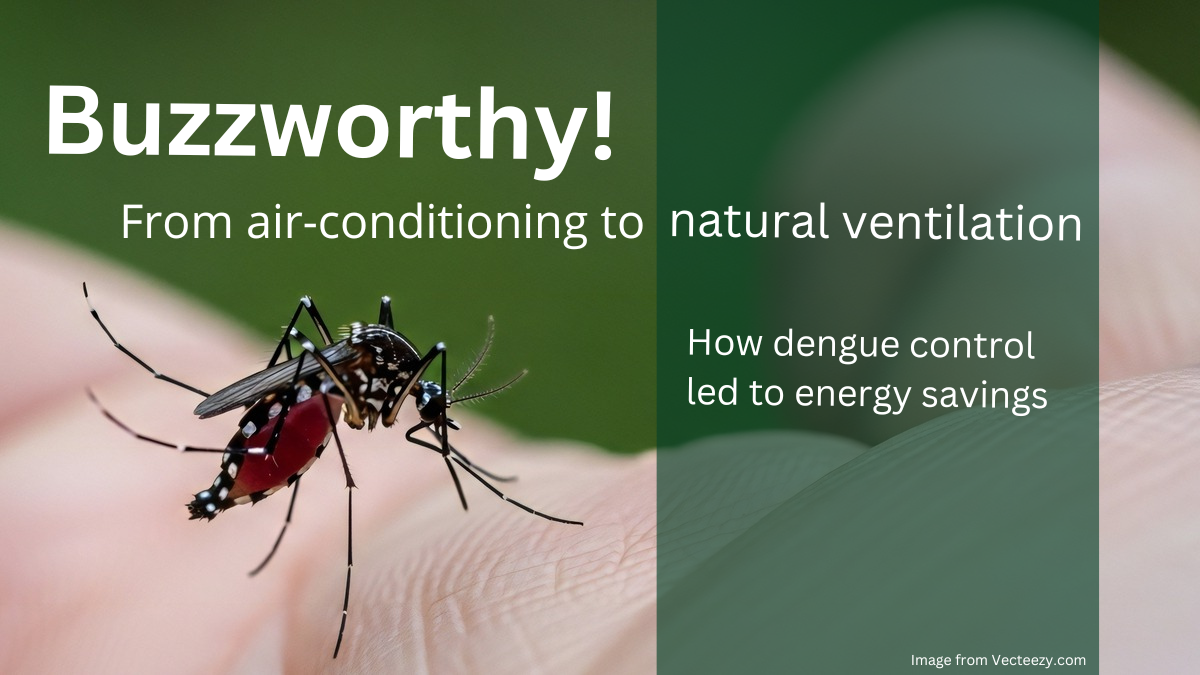
Dengue – an infectious disease primarily transmitted by the Aedes aegypti mosquito – thrives in hot and humid environments. As a tropical country, Singapore has to grapple with the complex challenges of managing vector-borne diseases within a densely populated, hyper-endemic urban setting.
As a stylised fact, households keep their windows closed and rely on air-conditioning for ventilation amid a dengue outbreak, which in turn raises residential electricity consumption. Against the backdrop of climate mitigation, this defensive behavioural response runs contrary to broader goals for reducing carbon emissions. There is, therefore, a pressing need for authorities to balance immediate disease risk management with long-term environmental sustainability.
However, in their study “Buzzworthy Solutions: Dengue Control and Energy Consumption”, Agarwal, Chen, Fan, Qin and Saxena reveal that this dilemma might be resolved by the Wolbachia programme rolled out by the Singapore government in phases from 2016 onwards.
Project Wolbachia
Launched by Singapore’s National Environment Agency (NEA), Project Wolbachia involves releasing male Aedes mosquitoes infected with the Wolbachia bacterium into targeted neighbourhoods. When these males mate with wild females, the resulting eggs do not hatch, which effectively suppresses the mosquito population over time.
The results have been striking, achieving over a 90% reduction in the wild Aedes population and an estimated 70 – 80% drop in dengue cases at treatment sites.

Establishing the baseline
Before proceeding with their study, Agarwal et al. had to establish the baseline relationship between disease risk and energy demand. The researchers documented a key stylised fact – that higher local dengue incidence is consistently associated with increased residential electricity consumption.
However, these initial observations remain associational and do not, on their own, identify a causal relationship. To definitively link the two, the researchers required an exogenous shock that the Wolbachia project provided.
A quasi-natural experiment and its findings
The staggered rollout of the Wolbachia project, particularly during its comprehensive Phases 2 and 3 in Yishun and Tampines between 2018 and 2019, provided a robust quasi-natural setup which allowed Agarwal et al. to isolate the true impact of diminished disease risk on household energy use. By merging the intervention timeline with monthly utility data across more than 5,000 residential blocks, the study yielded compelling results.
Wolbachia deployment led to a statistically significant 4.7% reduction in residential electricity consumption within treated blocks (which included both HDB flats and private housing). A more granular analysis of HDB public housing further validated this trend, revealing average monthly electricity reductions of 3.4% for 3-room flats, 4.0% for 4-room flats, and 4.2% for 5-room or larger flats.
By systematically removing an environmental threat, Project Wolbachia had apparently encouraged households to proactively pivot from energy-intensive air conditioning to natural cross-ventilation.
To verify that a shift to natural ventilation drove these energy reductions, the researchers conducted rigorous heterogeneity analyses. They found that the electricity reduction effect was significantly more pronounced during cooler periods, precisely when natural cross-ventilation becomes a compelling alternative to air-conditioning.
The impact was similarly amplified in residential blocks possessing superior ventilation conditions. Conversely, the estimated effects during hotter months or in poorly ventilated blocks were found to be weaker and statistically less precise. These results provide robust empirical support for the natural ventilation as the preferred choice – households are more likely to pivot away from air-conditioning when environmental and structural conditions render natural ventilation a feasible alternative.

The economics of Wolbachia intervention
Making an assumption that Project Wolbachia was implemented nationwide, Agarwal et al. estimated annual savings arising from reduced air-conditioning to range between S$68.4 million on the lower bound to S$147 million on the upper bound. These figures are contingent on the prevailing electricity tariff and the total volume of national residential electricity consumption.
From a strategic policy perspective, the fiscal argument for the programme is compelling. With the estimated annual cost of a nationwide Wolbachia rollout pegged at approximately S$40 million, the energy savings alone generate a net economic benefit of S$28 million to S$107 million per year. Notably, this surplus is achieved before factoring in the primary direct healthcare savings and recovered workforce productivity associated with lower dengue incidence.
Policy implications
The primary policy implication of this research is that public health interventions can serve as an effective, albeit indirect, tool for demand-side energy management. By demonstrating that the systematic reduction of vector-borne disease risk allows households to shift from energy-intensive air-conditioning to natural ventilation, the study highlights an opportunity for a cross-functional approach that integrates environmental management, healthcare and real estate development.
For example, the study’s findings underscore the utility of cooling architectural features that promote ventilation – which in tandem with effective vector disease control – can significantly amplify the decarbonisation potential of the built environment.
Agarwal, Sumit is the Low Tuck Kwong Distinguished Professor at NUS Business School and professor of economics, finance, and real estate at the National University of Singapore.
Chen, Yifan is a PhD candidate at the Department of Real Estate, NUS Business School National University of Singapore.
Fan, Mingxuan is an assistant professor in the Department of Real Estate, NUS Business School, National University of Singapore.
Qin, Yu is the Lum Chang Chair Professor in the Department of Real Estate NUS Business School, National University of Singapore.
Akshar Saxena is an assistant professor of economics at the Nanyang Technological University.