

The price of heat – how high ambient temperatures erode property values
Research by Zhan, Qian, Zhang and Yuan (2026) reveals that ambient heat carries a financial penalty in the resale housing market and points to urban morphology as carrying the most weight in driving down home prices.
29 Sep 2026
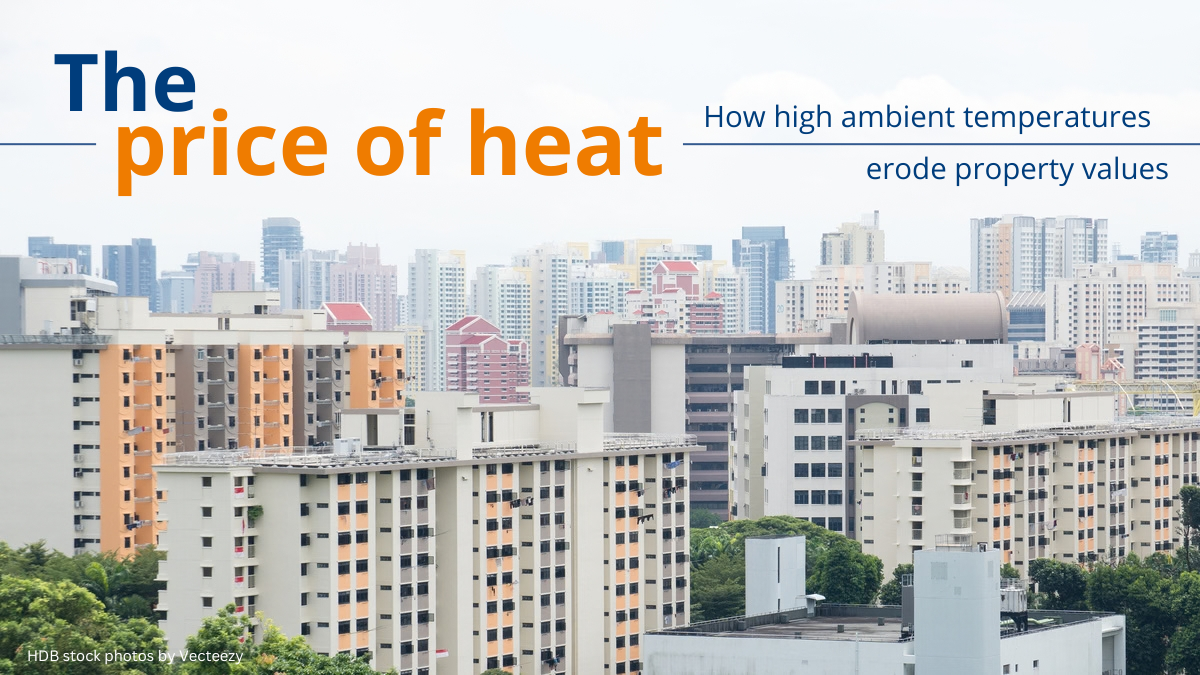
In Singapore’s dense, tropical urban landscape, residential property functions both as essential shelter and a primary store of wealth, typically accounting for more than 40% of household net worth.
Yet, as global temperatures climb in tandem with rapid urbanisation, what are the hidden externalities created by these converging forces? Will resident wellbeing be compromised, and could urban heat actually erode property value?
Central to these concerns is the concept of the microclimate – the micro-level atmospheric conditions shaped by urban morphology, vegetation, and anthropogenic heat such as air-conditioning exhaust – which can differ markedly across very short distances. For example, a block situated along the open edge of an estate may enjoy natural cross-ventilation and open skies to dissipate heat, while an identical block nearby – boxed in by surrounding towers and bombarded by neighbouring air-conditioning compressors – can sit in a stagnant, significantly hotter air pocket.
In their paper "The price of heat: Impacts of microclimate on household wealth" (published in Cities, 2026), Zhan, Qian, Zhang and Yuan investigate the impact of micro-level ambient heat on residential property value, observing a negative correlation between localised ambient temperatures and housing transaction prices.
At the market level, properties penalised by this "heat discount" command systematically lower transaction prices, demonstrating that thermal discomfort is actively capitalised into real estate assets.
Measuring microclimates block by block
To understand how ambient temperatures are priced into property values, the researchers turned to Singapore’s HDB resale market.
Unlike new Build-To-Order (BTO) flats – which are centrally priced and heavily subsidised by the Housing & Development Board – resale flats are transacted through open, bilateral negotiations. Prospective buyers typically visit the flat during viewings, allowing them to physically experience the home's living conditions, including its thermal comfort. Because more than 80% of Singaporeans live in HDB estates, this resale market provides an enormous, real-world testing ground.
To quantify and measure what buyers were experiencing, Zhan et al. mapped the outdoor ambient temperature within a 100-metre radius around every individual residential block in Singapore using high-resolution microclimate data modelled in 2015. They then tracked how these baseline conditions influenced subsequent property transactions across 2016 and 2017.
The researchers further broke down the outdoor temperature at each block ("AmbientTemp" ) into three distinct layers:

Ta,bg (the natural baseline) is the average nighttime temperature of Pulau Ubin in 2016, representing Singapore’s natural, unbuilt baseline temperature. ΔT measured the impact of urban morphology (e.g. high-rise towers clustered together, amount of visible sky to vent radiation), while AnthroHeat captured direct man-made heat emissions, predominantly the hot exhaust discharged by residential air-conditioning compressor units.
Findings – the cost of a warmer block
To isolate whether higher ambient temperatures genuinely penalise flat values - and ensure the model was not simply capturing poor locations or subpar neighbourhood amenities - the authors implemented 3-digit postal code fixed effects and also other controls for property and location attributes, as well as weather conditions.
In Singapore’s urban layout, a 3-digit postal code corresponds to an immediate cluster of roughly 13 neighbouring blocks. Within such a tight geographic radius, macro-locational attributes are essentially constant e.g. distance to MRT stations, schools and other facilities.
By comparing blocks strictly within these homogeneous clusters, the empirical findings revealed a 1.5% heat discount: for public HDB resale flats, each 1 degree Celcius increase in localised ambient temperature results in an approximate 1.5% penalty on transaction prices. According to the authors, a 1.5% depreciation translates into an average penalty of S$6,600 per property in the resale HDB market.
Examining the private resale condominium market, where buyers similarly conduct on-site physical viewings, the authors identified a comparable and statistically significant 1.2% discount per 1 degree Celcius, confirming that thermal disamenities affect property valuations across the public and private housing markets.
Given that Zhan et al. defined ambient temperature as the sum of heat produced by urban morphology (ΔT) and residential heat emissions ("AnthroHeat" ) on top of the Pulau Ubin baseline, the authors were able to unpack this composite metric and separately evaluate the impact of the built environment versus air-con exhaust on resale prices.
Their analysis revealed that urban design carries significantly greater weight than human emissions. A one-standard-deviation shift in the “Sky View Factor” – an urban morphology index measuring how tightly buildings cluster together and obscure open sky – is associated with a 10.0% to 10.1% decrease in public housing resale prices. In contrast, a one-standard-deviation increase in residual anthropogenic waste heat yields an estimated price penalty of up to 8.8%, though this effect loses statistical significance under the strictest model specifications. The researchers therefore concluded that development density is the key driver of ambient air temperature-related changes in property prices, and such a finding is highly salient to urban planning and design practice.

Policy implications
The authors noted that in 2023, there were more than 1 million public property units in Singapore, and the average resale price per unit was around S$0.6 million. Therefore, a 1-degree increase in ambient temperature can be translated into substantial losses in household wealth alongside potential health risks arising from thermal disamenity.
For policymakers, the research underscores the importance of mitigating and adapting to urban heat problems through targeted interventions. Zhan et al. suggest that urban planners should prioritise building morphology strategies. Given that sky view factor drives most of the price impact, re-zoning and height controls may yield more immediate benefits than longer-term energy efficiency programs alone. Additional measures could include increasing green spaces, adopting cooling technologies, and prioritising heat-resilient designs in future public housing development plans.
Zhan, Changwei is an assistant professor at the Department of Real Estate and Construction, University of Hong Kong.
Qian, Wenlan is the Ng Teng Fong Chair Professor in Real Estate and professor of finance and real estate at the NUS Business School. She is concurrently Director of the NUS Institute of Real Estate and Urban Studies.
Zhang, Liqing is a PhD student and research assistant in Urban Climate Design Lab, Department of Architecture, National University of Singapore.